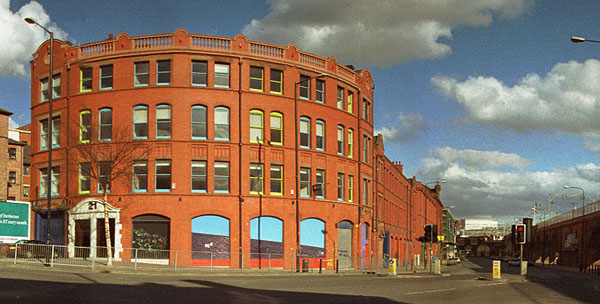
In the year 2014, Whitworth Street West, Manchester city centre, house a block of new build flats. Big, strong and sleek in design, the monstrous symbol of the modern age is simply adorned with the sign 'FAC51', on the left hand side of an entrance into an underground car park. Non enthusiasts and people of a certain age group would be unaware of the Cultural Revolution that took place in this very spot, giving birth to a renaissance of British culture in the global scene and inadvertently changing the face of British youth culture forever. "The Hacienda closed in June 1997 after which it stayed empty for eighteen months before it was demolished" writes resident DJ David Haslam. "Bits of the demolished club were then auctioned off. Bricks were £5 each; the sale raised thousands of pounds for charity. Now on the site on Whitworth Street there’s a block of flats mocking us with its use of the Hacienda name."
WELCOME TO THE FACTORY
32 years ago, to this day, FAC51/The Hacienda opened for the first time according to those that attended, the sound of the music and the good vibes in its early stages made an impression that would last with them for decades to come, with the tremors and influences of the club still notable in British culture today. Translated as an 'idealised co-operative community', The Hacienda served its function as providing a space to celebrate divergence, difference and subversion (despite its financial problems and social troubles) it spearheaded a vibe that's ruling clubs all over Europe in the present day. From layout and style, to social movement, musical legacy and financially-hindered demise serves as the most famous establishment to have come about from the Acid House explosion and a multi-faceted tale of the do's and don'ts of running a club.
FORM & FUNCTION
Anthony Wilson and Rob Bretton started the Hacienda at FAC51 as a protest of sorts, towards the glitzy glamorous and hollow feel of clubbing at the time and the darkly moody post-punk scene that had marred the end of the '70s decade. A landscape that was ruled by vanity mirrors, chrome furnishings and beer soaked upholstery these establishments were ruled by dress codes and the ruling status quo. Introducing a raw warehouse vibe different in the fact that it would remain in the same spot for years to come as opposed to the illegal rave culture circling the m25 down South its construction was the complete antithesis to the disco era. An enveloping hall of metal, glass, wood and safety stripes, The Hacienda's function of putting music and the experience of music first was at it's very core and proved the catalyst to its popularity. Ben Kelly, designer of the club, stated "I had perhaps the arrogance to think I could interpret what I thought Factory was about from a two dimensional point of view, in record sleeves, and also attitude of the personnel involved into a three dimensional environment" on the official website of The Hacienda. "It was just an attitude. It has an original, unique and regional quality to it. It was like-minded people from different disciplines homing in on a common cause. It's hard to put a name on it."
THE FACTORY LINE
The Hacienda as captured by Ben Kelly's design was created as an extension of Anthony 'Tony' Wilson's burgeoning and often controversial Factory Records. A label that was steeped in the ethics of the earlier punk movement (which saw the rise and fall of one of their largest signings, Joy Division), Factory Records was known for its shape shifting and laid back approach to upfront and, at times, challenging music. The imprint had earned it's stripes through bands such as Joy Division and Cabaret Voltaire, the Hacienda came as a shock to the local community and reflected JO's morphing from trench coat punks to New Order. Mixing the sounds of electronic dance music and indie-rock, the cultural club and hub came as a shock to those of the previous musical era with electronic dance music and indie-rock. Mike Pickering one of the resident DJs, Hacienda bookers and later of pop group M-People said “People were still into the raincoat-brigade-Joy Division-thing so when we came along they were like, ‘Trendy bastards!’ he spoke of the transitional period from new wave punk to the acid house explosion. "We might as well have come down from another planet.” The Hacienda had no rule book, no guidelines and no hidden agenda it was, essentially, finding its feet along the way. Eventually racking up tens of thousands of pounds of debt, the club was in financial trouble 'from the moment it opened' yet this didn’t stop it from kick starting two musical movements and becoming one of the coolest and most celebrated clubs the UK has have ever produced.
MONEY MONEY MONEY!
As widely reported in various articles on the web, The Hacienda also left another legacy in the form of responsible financial running. Tales of financial mishaps at the club are forever abound including rumours of a 25 year lease, a £30,000 sound system that blew 18 of its 20 speakers on the opening night and Wilson’s rather utopian view that the club should be open seven days a week. And along with the queues, came violence, as the club's commercial viability and mass popularity grew. Beatings, stabbings and shootings gradually supplanted the euphoria. Its clientele was scared off, and the Haçienda eventually closed in 1997, bankrupt. The band worked out that in the 15 years the club had been open, each clubber through the door had cost them £10. “If I’m ever skint, I’ll walk around Manchester asking everyone to give me my tenner back" jokes New Order bassist Peter Hook dryly in his somewhat-confessional and emotional book, "The Hacienda: How Not to Run a Club".
For all its turbulence, impacts and highs (and the lows), it's these many factors that have contributed to the Hacienda's legendary status as an establishment that will remain significant and within people's hearts. From Madonna making her first UK TV appearance filmed at the club (reportedly booed after miming) to German industrial noisemaker Einstürzende Neubauten nearly frying himself after drilling into the clubs power supply with a drill during his performance, it's ground breaking, two-fingers to the norm feel and style may be commonplace in today's modern landscape but back in its heyday, The Hacienda represented more than just a nightclub and more than just music. With every stage and milestone of the club’s history surpassing the last in terms of impact and cultural resonance, FAC51/The Hacienda represented a cultural revolution, one that was defiant despite the odds ‘til the very last breath. A car park space and posh block of flats that’s got more than its fair share of stories to tell.